
Matthew Malcolm ADD
Matthew Malcolm Interview - Push The Music Out In The World
02/20/2026 by Munchy
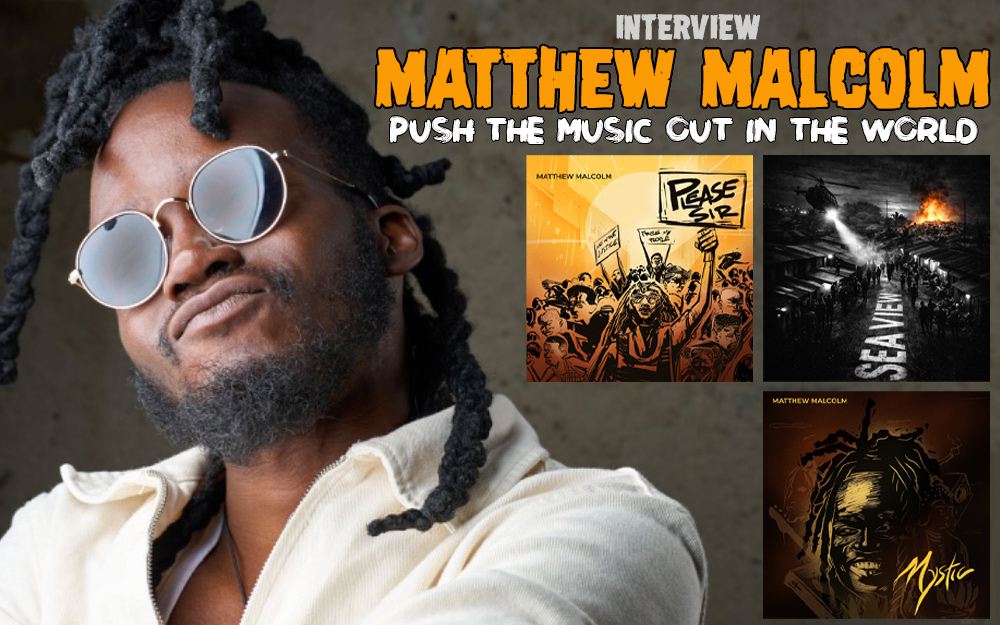
"WE HAVE A RESPONSIBILITY WHICH IS TO PUSH THE MUSIC OUT IN THE WORLD."
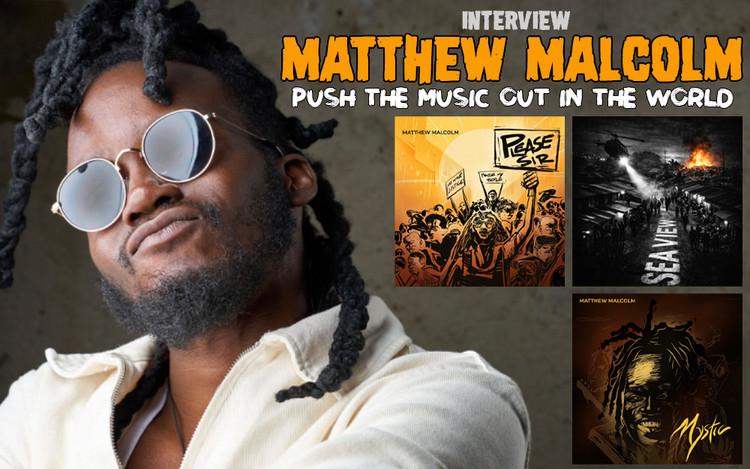
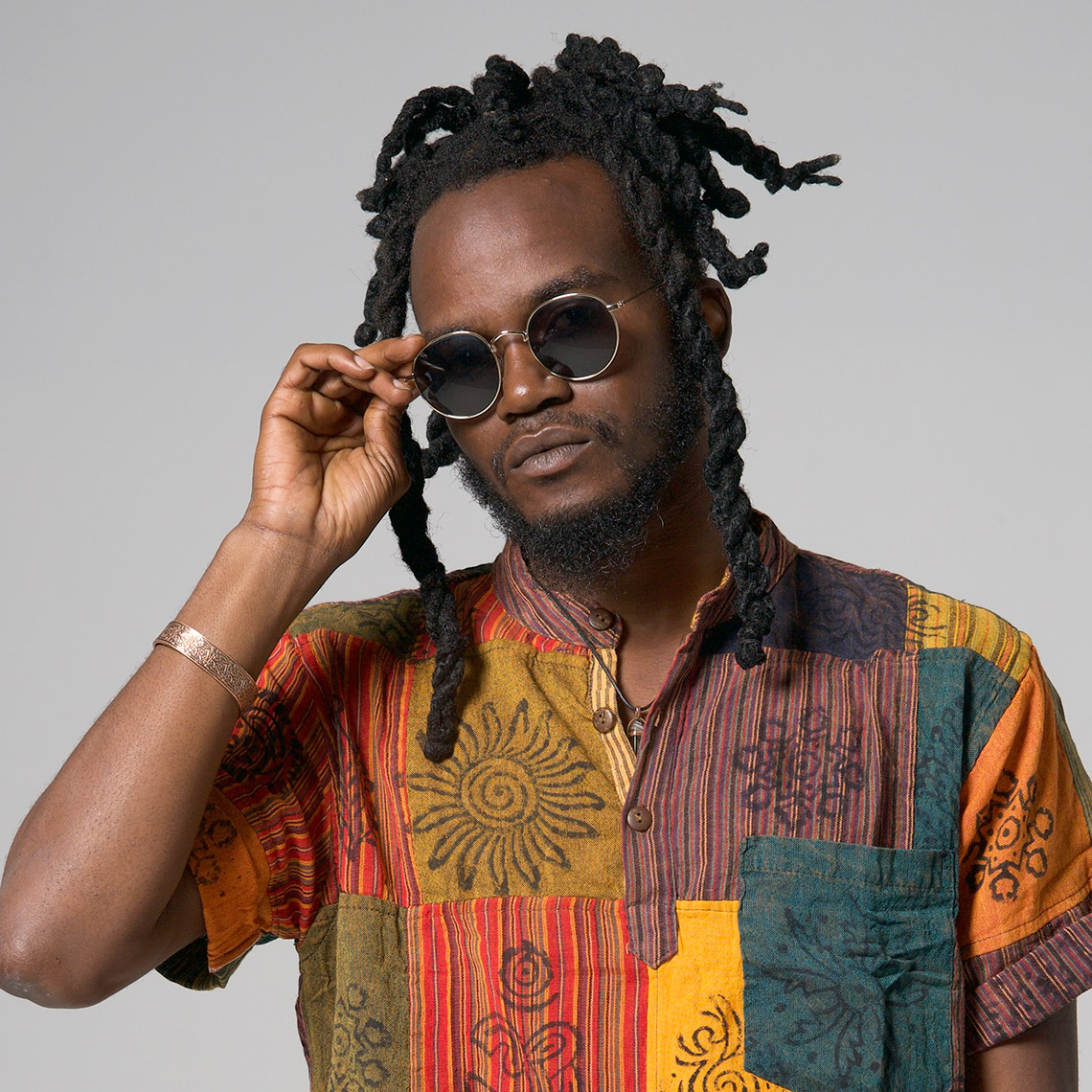
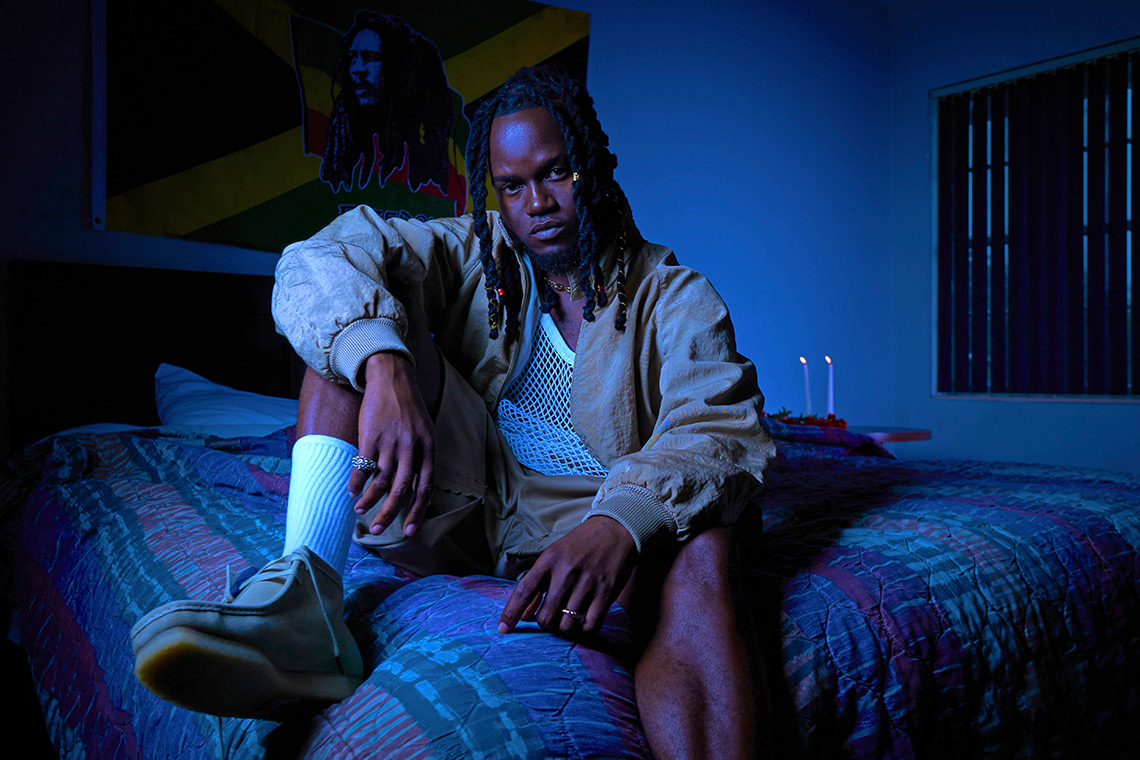
Kingston-born artist Matthew Malcolm represents a new generation rooted in Jamaica’s rich musical legacy while carving out a path of his own. Coming from humble beginnings in the hills of St. Andrew and growing up with limited resources, his journey has been shaped by faith, family, community and an unshakable sense of purpose. A member of the vocal trio sensation The Rising Suns and part of the cast of the Bob Marley: One Love movie as young Seeco Patterson, Matthew continues to expand his artistic reach, also with his brand new single Seaview out February 20th. In this conversation with Munchy, he reflects on growth, responsibility and the drive that fuels his craft – sharing why carrying the culture forward is both privilege and duty.
Matthew, this interview serves as an introduction to our Reggaeville family: Matthew Malcolm Blake, born 1997 in Kingston, Jamaica grew up in the hills of St. Andrew. Hall’s Green, Zion Hill, Lawrence Tavern, that area. Is that correct?
You are so on the spot. All your information is correct.
So, tell me about your childhood and your upbringing. You lived with your extended family and life was not always easy…
For sure. It started in church. We were Seventh-Day Adventists. In those times we used to have youth groups within the churches. We would do the Praise and Worship for the church every Saturday and Friday night. We decided to form a group, as young as we were. I was a baby, maybe around six at that time. It was my older brothers who ventured into forming this group called Archangels. They performed at many of the local churches and schools and that was the first introduction for me to music. That was the first time I said to myself “I want to do this forever! This feels like something that is my calling.”.
At six years old at that time, I didn’t know anything about harmonies or music, I was just loving the vibe. When I was about seven or eight, my brothers entered a competition in high school called All Together Sing and they were champions in 2005, 2006. I was in primary school and at that moment I felt “They’re doing something great. I need to do something great! I need to add to what they’re doing.” Naturally, at every little fun day they had at the primary school, at every teachers’ meeting, you name the event, I would ask any teacher “Could I sing? Could I get a chance to sing a song?”.
Sometimes they said yes, sometimes no. For the ones who did say yes, they had me on groundbreaking platforms such as the parents’ teachers’ meetings, where I was introduced to adults who are spending their money on music, who are listening to music, so it wasn’t like in the kids’ hands anymore. Once I got introduced to the adults and started performing more and more, they started requesting me more and more for these types of events. The formulation came where they said “Oh, your older brothers are the ones who won the competition All Together Sing.” So, everybody was like “Oh, ok, so there is a third one.” The whole excitement began right there.
And speaking of the struggles and the music… even at that time we had to get aid from the teachers who saw and knew that we were struggling as kids because we grew up in a house where there was a single mom raising three boys. That was very technical on the financial side or just any side you could think of. But during that moment as again we found music, and we found a bond with each other, so we didn’t even know we were growing up in struggles because we had something as good as music that was still taking us places. It wasn’t putting any crazy money in our pockets, but it was allowing us to meet different people and see a different life. The struggles were there, mainly financially, but we were more focused on the gratitude of what we were receiving.
Was music a way out and a chance for you guys? Or did you more stumble upon music as a distraction?
No, I can tell you, music saved us. Because we grew up in a place where, at that time 15 years ago, it was not like now where everybody could see their direction in life. 10, 15 years ago it was more edgy. People weren’t so forward thinking or ahead of time with technology or these things. When I say “Music saved us” it was more like, we were born at the right time in the right place surrounding ourselves with the right people. Because I grew up in a place that is a sound system community. I could have been anywhere else: uptown, somewhere where there is no music or just like hey, you’re from a Christian background, you shouldn’t be exposed to certain music. But thankfully to our mom and the people that raised us, they were big fans of music. My grandfather was mentally ill but he was a huge, huge fan of music. He could sing like… I can’t sing (laughs), I’m not a singer. He is the real, real, real singer. He’s the real legend in the family.
We were always involved, as I said as young as we were, and growing up, especially in that community where it wasn’t so easy, I think even for us we saw where music saved other people, other kids. When we had these events, when we had these youth groups, they would literally do everything to be there. And we see them now in the streets, we see how they’re operating, some of my friends from back then, they’re on my team right now. Music is not just something that came out and saved Matthew Malcolm. Everybody around me has a story for it.
You mentioned that you started at a very young age. You were part of a group, the Paragon Boys…
Yeah, so it changed from Archangels to the Paragon Boys, then from the Paragon Boys to Total 5.
And that was with your two older brothers, Jermaine and Jerome, and two more guys.
Yes, that was with a next guy named Jermaine Campbell and Owayne McCaulsky.
How old were you when you first started in the group and how was working with them like, especially having in mind that you were still in school?
I was 12, maybe going on to 13, and the youngest. Everybody else was out of school. When I left school in those days, I would have to end up at Edna Manley College. This was maybe an hour and 35 minutes from Kingston. I had to leave school after 2:30 pm to head to Edna Manley in the days to rehearse with these older guys and the group. I was the only person in a school uniform in College (laughs), just coming in. Most of the people who are playing for me right now, remember that. They’re like “Oh, yeah, we remember you from you were this young!” I was not older than 12 years when I just joined the group. I still didn’t have much experience; I was just excited to learn the business. At that time, we had Glen Browne as a mentor. For me it was a big deal to leave school and go to work. That’s what I looked at it as (laughs): leave school and go to work.
But that shows already that you had a very professional approach, that it was not just for fun.
For sure! I saw people’s careers like Kabaka Pyramid, Chronixx, Jesse Royal… I have seen their careers blow up. I was, again, a baby at that time, but I would go and watch all the events they had at Edna Manley, all the events they had around Kingston, all the Wickie Wackies, all that. I was just there, looking at them like “Hey, these guys started from here…”, when Chronixx had his little beenie beenie locks, as far as that time. I used to watch Kabaka and them on the stage and I was like “Yo, listen, THIS is what I want to do. This is what I want to become.” The inspiration of just watching these guys helped me to realize that the business is something that’s very serious and the younger you learn it, is the better for you. That’s just the inspiration.
But the group, that was not the only place where you, as a young kid already, sang quite successfully. Also, as part of the Oberlin High School’s school choir you even won some titles. Tell me about those performances and the awards you received.
I wish I could go back in time right now and get back some videos from these Nokia and Samsung old phones because those were the most epic times. Especially, when we won All Together Sing in 2010 and we came back with the championship, mind you, every time we had an event it was mind blowing. Kids, adults were losing their minds, thousands of kids screaming, and I was just looking at that: Yo, this is what music is supposed to feel like! You’re supposed to be your best and people see that they’re experiencing the best right now. Losen your tie and let it lose! Enjoy the good vibes!
Those times for me, winning championships like All Together Sing or JCDC, which we won a lot of… JCDC was one of those competitions we entered every year. We would watch it pay off by, again, people being really entertained and looking at us, as if we are the future of music based on the fact that we weren’t trying to do anything that was current but we were going to the past as far as the Frankie Lymon & the Teenagers, as far as the Jackson 5, as far as you could think back. And we were modernizing these songs. So, people were like “Yo, what’s happening right now?!” It was one of those weird phenomenon kinds of vibes. I know in high school, they were experiencing that as well because a lot of people I see now, they’re telling me “Yo, when you were performing in high school, it was something!” And not just me, the group, the choir, anybody performing at that time, it felt like it was something big. Like you were a part of history. I hope I’m explaining it right. It did feel like we were a part of history for more than just the All Together Sing, the JCDC; just the time, the feeling was different.
For those outside of Jamaica who are not familiar with JCDC and its importance, because it appears in quite some artists’ biographies, could you explain to us what JCDC is and of what significance it is to young aspiring talents in Jamaica?
JDCD for those who don’t know is the Jamaica Cultural Development Commission that focuses on developing people who have interest in creativity: dance, music, painting, you name it. They start from primary schools, high schools, colleges and you’re getting that experience. If you don’t have any experience anywhere else, on any stage, you could go get some experience right there. But when we were performing at those times it felt like it wasn’t even a competition. We were like “Hey, that’s cool!”. I was a fan of Aabuthnott Gallimore, which was the school Romain Virgo had gone to. These guys were at JCDC, All Together Sing, and I would have done anything at that moment, I was like “Oh, Virgo is on stage?! I need to watch this!” (laughs) It was that type of thing that exposed you to new audiences, new music. As the name suggests it’s development.
How did your career develop after Total 5 and the school choir?
I’m a determined type of person. During Total 5 days we were a group but also not so much of a group, because everyone had their responsibilities. You had older guys who had kids or were just starting to have kids. They needed a job because they needed to feed their family. Everybody saw where the shift was going to take place. Well, I saw it. I saw it from very early that this shift was going to take us to a new place because now people were turning up late for rehearsals, we’re turning up late for shows. And again, as you suggested earlier, I take the music very seriously. It’s not just to go inside the booth and sing a song. The business for me is very, very serious. And the shift began right there. I was seeing that now we were about to have different directions. You are maybe going to manage a hotel, while I’m going to still do music, and that’s fine. You have your bills to pay.
I just decided that the only way to do that was to record my first few songs by myself. It took me great determination because my first song that I wrote and recorded, I wouldn’t want to say this because he is going to see this, but the first person I brought it to, he was like “What are you doing with this? Where are you going with this?” (laughs) And I was shocked because from the studio that day I was playing the song for everybody I saw. Coming from the studio I was like “Yo, listen this track! Listen this track!” and everybody was giving me the thumbs up. And the one person I’m expecting to be like “Nice, nice, nice. That’s your first track? Keep going!”, he was like “Where are you going with this?!”
That chipped in a new motivation because my belief system is that when people “tear you down” you can take it as a tear-down or you could take it as building up yourself. We all have ego, we all know that we are great but when someone looks at you who you hold dear to yourself is like “Hey, you’re not all that. Let me break you down. Let me tell you about your voice, let me tell you about how you write your music, let me tell you how you act when you go outside.” When they give you that whole breakdown, it’s humbling. Because once you build back, nobody could break you down again. You already know going forward, what it is. So, it was that type of determination and drive that no matter what comes my way, no matter how much time I was torn down, it’s gonna be like “Hey, we gonna get up, brush off, stronger, and we’re gonna fix all the imperfection!”
What year was that when you did your first recording?
This was about 2014.
After all these years in the group, in the choir. How did working “on your own” all of a sudden feel?
It was challenging because just like anything in this life, if you start a game right now, in the first stage it’s gonna be easy like “yeah, you got it” but then you hit a mark where you can’t skip the line. You have to learn what you need to learn, pay your respect, pay your dues. Come back to this thing and try again. I had a lot, a lot, a lot of hurdles in knowing myself, solidifying myself, my sound, my brand, knowing where I want to go. All of this came with time. Naturally, we as humans want things now on our time. We don’t want to be like “next year, next two years”. We don’t want to hear that. We believe if we have a fire now the fire can only get bigger. But sometimes water gets thrown on that fire and you have to learn to light it up again, raise up the thing. And you’ll be good. Once you have determination in life and Christ, you’re alright.
You mentioned determination a couple of times. What keeps you going? What keeps you motivated?
To be honest, it’s the people around me. First of all, I have a really, really great team. I have a great management team, which is Sharon Burke and Debrina, my road management Wolf Management, I have an awesome production team Urbanvillah with a new band right now called Urban Reserve, and I have one of the sickest producers in Jamaica right now. His name is Pelle, from Urbanvillah as well. When you think about what it takes to be or break a good artist these are the fundamentals: good production, good team, and an artist that’s truly dedicated, who can wake up at 1 or 2 o’ clock in the morning and is ready to go. (laughs) I don’t even see it as work because when we’re on the go, we’re on the go. We’re just moving and operating as a team. Everybody knows their role, and if anyone can only give 60% then someone is there to give you that extra 40%. We realize that this is a family! When you have a family as an artist it’s bigger than just having a team. This feels like a family, everybody knows their role.
Nice! Glad to hear! And that shows that you’re not really on your own. Eventually, you also joined another group. Last year you started the project The Rising Suns with Irie Souljah and Quan Dajai Henriques. Tell me how you guys met and how this vocal trio came about?
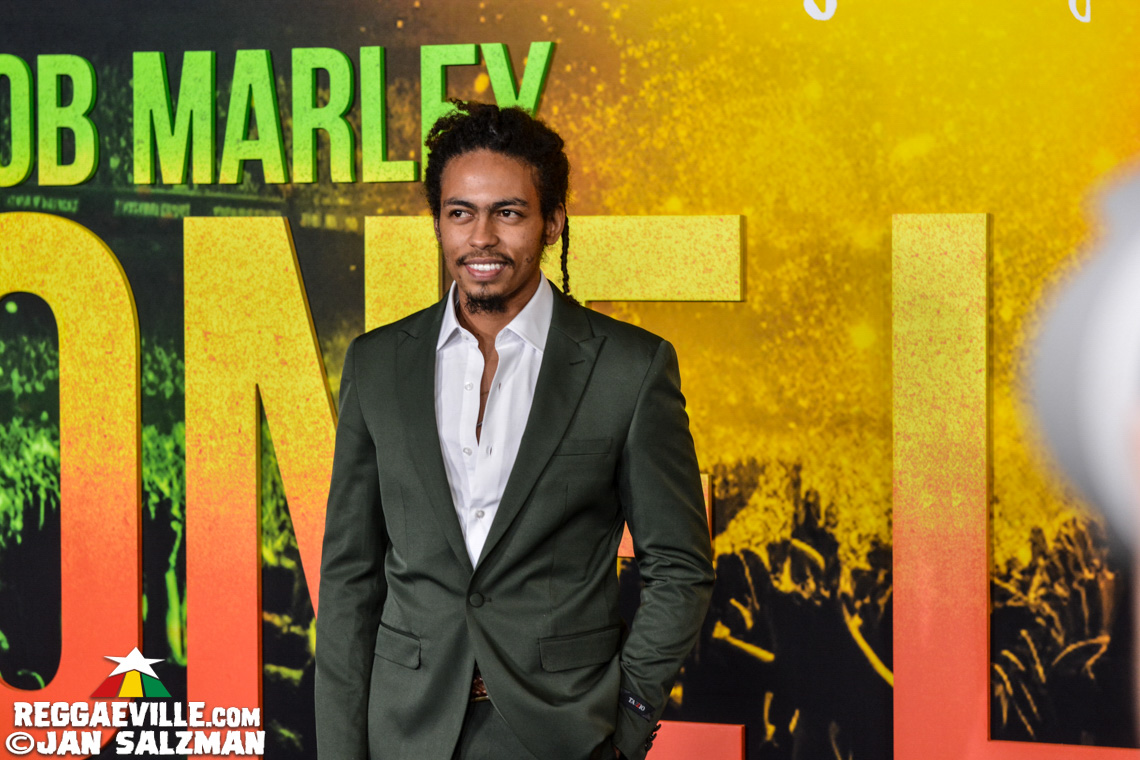
Initially, me and Quan met through the Bob Marley movie. We were co-workers on set. And then I was like “Oh, you do music for real?!” and he was like “Oh, you do music for real?!”. That kicked that off. Musicians love musicians, artists love artists. So, we’d always just link up in our trailers and would be making music like singing covers or trying to make new music.
I was always seeing Irie around Jamaica, performing in the scene. Then fast forward, I think a year ago, I realized that he and Quan would link up, like me and him did, and make music. So, it just happened one day. None of this was planned like putting a group together. It just happened. We were there chilling; I happened to have the Congo drum in my hands the day. At that time, I still wasn’t vast on playing any instrument or playing Congo drum much less. He just pulled up, two guitars were there and the first song we started was Stir It Up. We were just there vibing, making little sounds until we took up the guitar and said “Yo, are you hearing this?!” Everybody asked the same question at the same time. “Wow, did you hear that?!” Right there in that moment we linked up three days straight from that day. We saw how fast we were catching songs. We just had the idea out of the blue let’s do this every week consistently and just release a video. We are not going to call it any name, we’re not gonna say we’re in a group. Nothing like that because everybody had their own individual careers at that moment still going on.
I think it was our second video that we posted, Kabaka commented on the post “Yeah man, this is the new rising suns!”. We had just posted the video and were still sitting there same way and were like “Wow! That’s the name!”. But we were wondering what we are going to do because we don’t want get into people’s feelings if they see it’s not a group, we don’t want to trick the crowd. We immediately came to the agreement that the reggae industry right now needs this, as young faces, as young men in the industry. We need this as well as the industry needs this right now. So, we looked at it more as a mission of fulfillment when we brought back some of these older songs that people from our generation aren’t so familiar with. We even had the questions “Are you guys the original singers for these songs? What’s happening?” We had to put them onto history, hence why we started to do the whole caption, tagging these people back, basically giving them a small history of what it is. Our fifth, sixth or seventh video… it only got bigger.
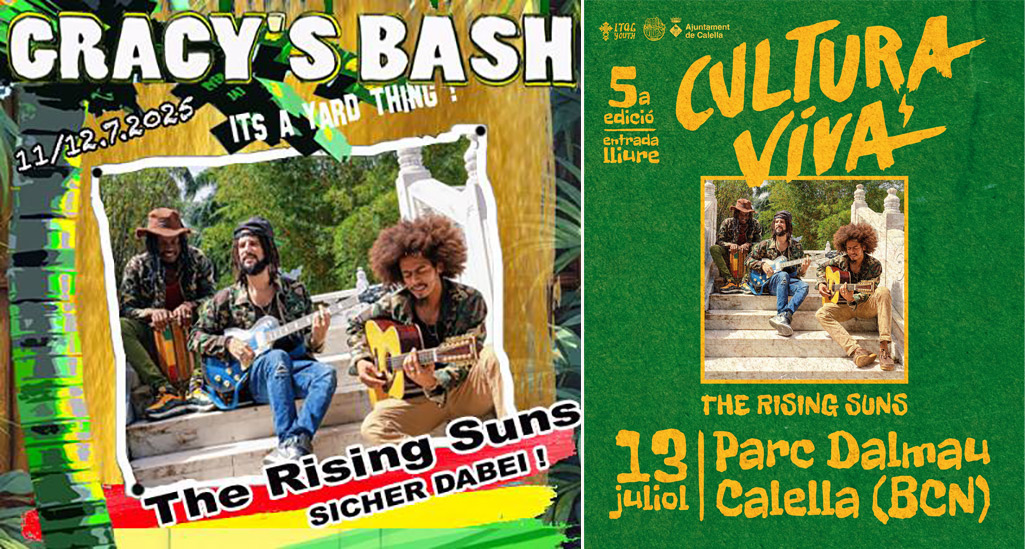
We started getting shows like in Europe - you saw us in Europe. “Alright, let’s do this for real!” Because even when you saw us in Europe for me it was still like “I don’t want to go in a group because I was coming out of a group with my brothers.” and that whole mental strain of groups. And everybody had the same “I don’t want to do this because of people’s feelings, somebody could switch at any moment” type of stuff. So, we said one thing: that this is not about us. It’s not about what we gain from this. It’s not about the followers or any of that. It is more along the line of spreading the message, refreshing back the memories of the legends that have passed, people that have come and paid their respects and paid their dues for the industry, for us to even have a chance to say “hey, we’re existing in it right now”. That was more along the line where Rising Suns is concerned.

Is this the reason why you haven’t released anything – yet? Is it really more this tribute sort of live project? Or can we expect something at some point?
Well, we have a lot of songs recorded. The only problem right now is that Irie just released his album. I’m currently curating a whole blow up right now in terms of rolling out with my songs. We didn’t want to confuse the audience in terms of straying from our individual work. People are waiting, of course, but we also know that this will be something of three individuals. It’s not just me that will get up tomorrow morning saying I’m going to try and push this song. Anytime that we are ready and I know the fans are ready to just hear some real good music, but we want to do it in such a way where they’re not missing out on what we’re doing in our individual careers. We’re just doing the works of Jah right now. We’re not trying to focus on “he said, she said” or pure emotions. We have a responsibility which is to push the music out in the world. And that’s what we have to do.
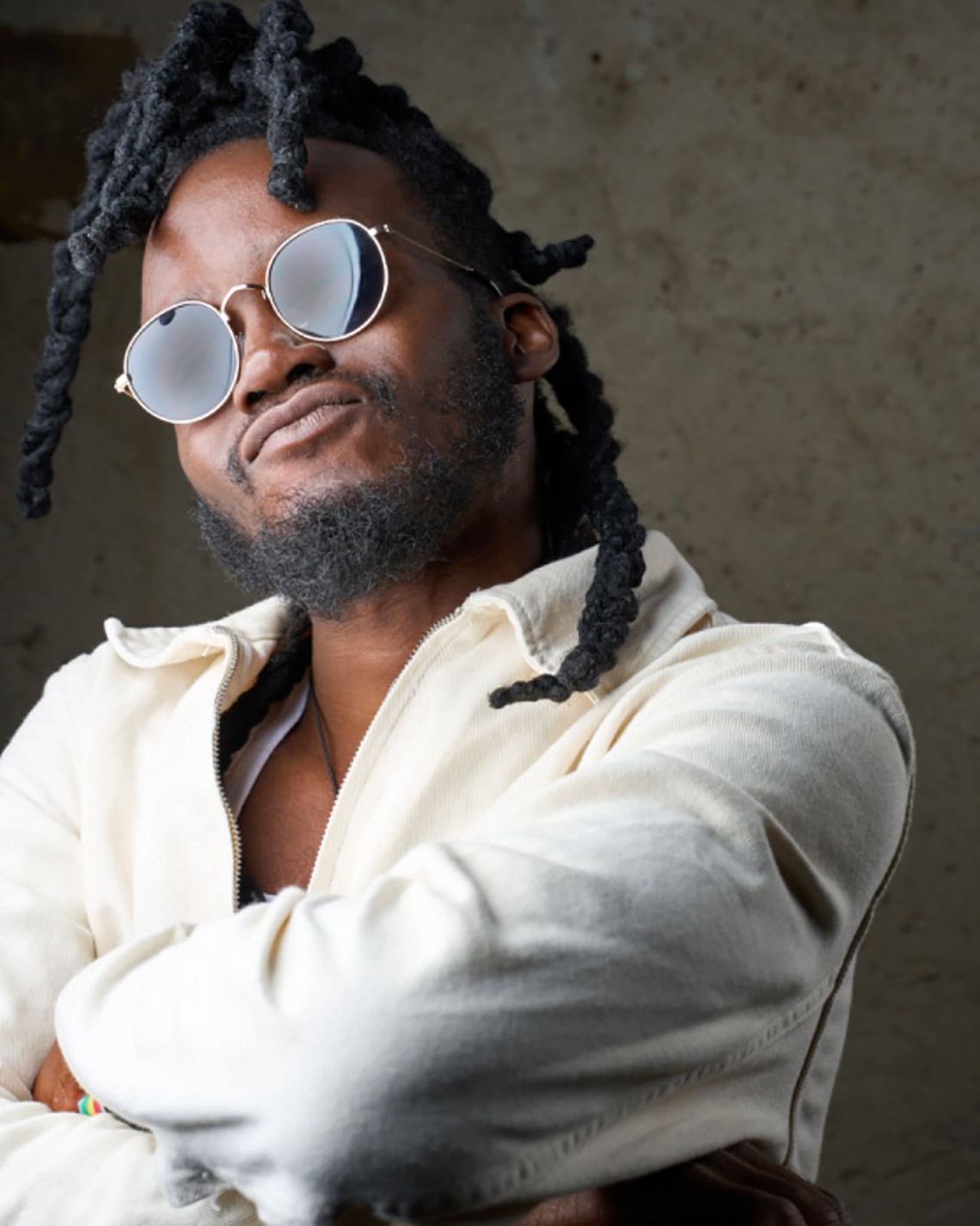
You mentioned that you met Quan Dajai at the set of the One Love movie, in which you played the young Seeco Patterson. How did you happen to join the cast and how was the experience of filming like?
I was just travelling with a friend one day. They saw the audition and decided they wanted to audition. To be honest with you, Munchy, I was like “Hmmmmm… noooo.” (laughs) That was my initial answer when they asked me. No. This was something I had no experience in. And I immediately thought it was a scam. Paramount coming to Jamaica to film a Bob Marley movie?! (laughs) It sounded so grandiose. I mean, we grew up on Paramount. So, let that just sink in for a bit: Paramount is coming to Jamaica, and you can audition as someone who has no acting skills. So, immediately I thought it was time-wasting. But then there was a follow-up for two, three days from the same person saying: you need to audition, you need to audition, you need to audition. Ok, I’ll only audition if I don’t have to go inside a place where people are going to be looking at me saying “take one” and all of that. I only agree if I could do it and send it via e-mail. Lucky enough, they were accepting that. Ok, perfect! So, I did the audition and about a year passed. A year passed, right?! It was ok because I saw that the filming was happening and I took it off my mind. They were in England, filming and all of that. I only saw it once and I assumed I didn’t get through because they started filming. Then like three months left in filming they were in Jamaica, and I got an e-mail one night that I was accepted in the movie to play young Seeco.
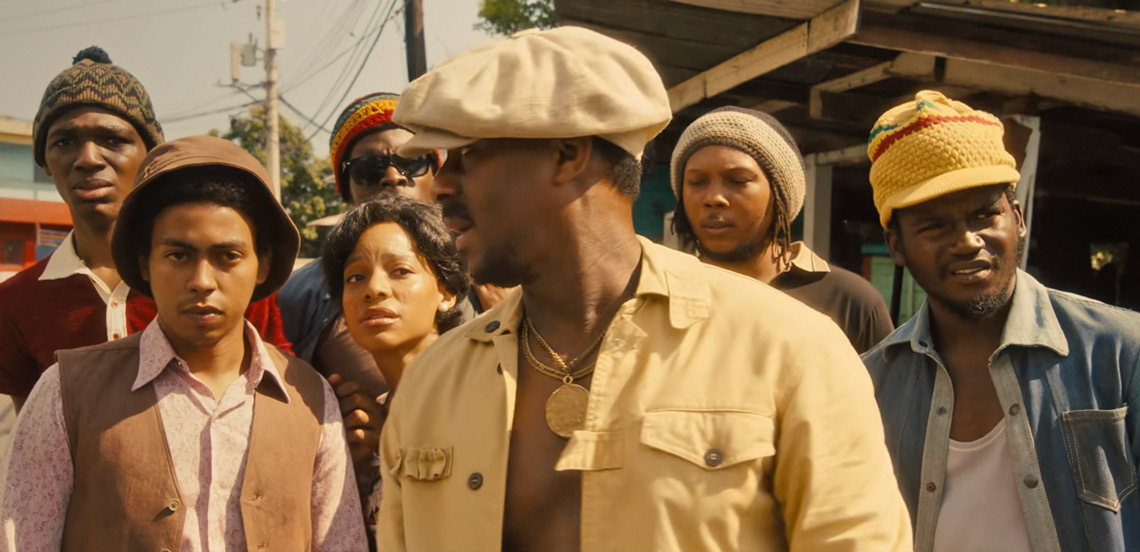
To be honest with you, Munchy, I read that e-mail ten times. Ten times! I’m sure I’m not seeing an e-mail right now from Paramount much less to say “hey, you’ve been accepted to play a role in a movie”. So, I sent it off to the same friend asking “Is this a prank? Or is this real?”. No! This is for real, for real, for real. This is what you’re gonna get paid, this is the filming date, this is what they’re gonna take care of. All of that. And to be honest, I went into a blank right there. From that moment I did three weeks of filming and I went blank right there because the moment was too unreal for me. Just being there in Trenchtown, reliving the life of this legend, Seeco Patterson. This was no joke. It was a big responsibility. How this man moved, how this man talked, his attitude towards anything. You had to totally shed who you were to now emulate somebody different. What made it worse is that at that moment he wasn’t there, he passed.
So, it was more along the line of doing research, watching a lot of films, speaking to people who knew Seeco. This was just, again, unreal for me. But right after the movie I could say that what I did gain was the experience of determination. Again, I use that word so many times. But I saw determination. The sun is hot in Trenchtown, it’s no joke. And when you hear the stories that this was the type of heat these guys used to have to walk in to go anywhere, they had to go, to shows, rehearsals, studio. They had to endure all of this before the glory. And even more than just the sun… when you talk about the real sufferation of musicians, they’ve endured that. I know a lot of musicians and artists go through that phase where we’re not so selling but those guys went through it, they emulated that whole story of an artist going through struggles, trying to make a days pay, trying to make something for themselves, not trying to get mixed up in a society where - at that time - was super violent. They went through the true hardship of the music industry.
How was it when you first saw yourself on the big screen?
Oh God, I had to pinch myself. (laughs) I’m kidding. But to this day it’s a joy to sit and turn on the Netflix whether on the computer or on the TV inside the house to watch myself on the screen. This feeling is… How do you explain it? What words would you use? As somebody who’s coming from a place up in a Hall Green, Temple Hall who has never had any experience in acting, who grew up without many things, many resources. If you looked at me 15 years ago and said “Hey, you’re going to be on a big screen, on Netflix, whatever, whatever” I’d be laughing “Ok… cool. Ha ha” Not because we didn’t believe in ourselves but there are some things you can’t see as a possibility until it happens.
Could you imagine doing more acting in the future?
For sure, for sure. I actually love being on film because it’s so much like music. When you’re about to shoot a music video you have to have the same level of focus, charisma and work ethic when you’re on screen. Because it’s like you’re wasting the director’s time, you’re wasting film, you’re wasting all of these good resources. It’s not like in the studio where you can do it so many times. You got to work with day light and if it’s night time, you’ve got to work with night time. The timing is way different. The tone, even how you speak… I didn’t know those things while going into music. Also how to do an interview. These are the things that acting brings outside of you. It makes you know that you are emulating something or somebody even if it’s yourself and it teaches you to switch. That’s what that’s for.
But for now, music is the focus still…
Music is my baby.
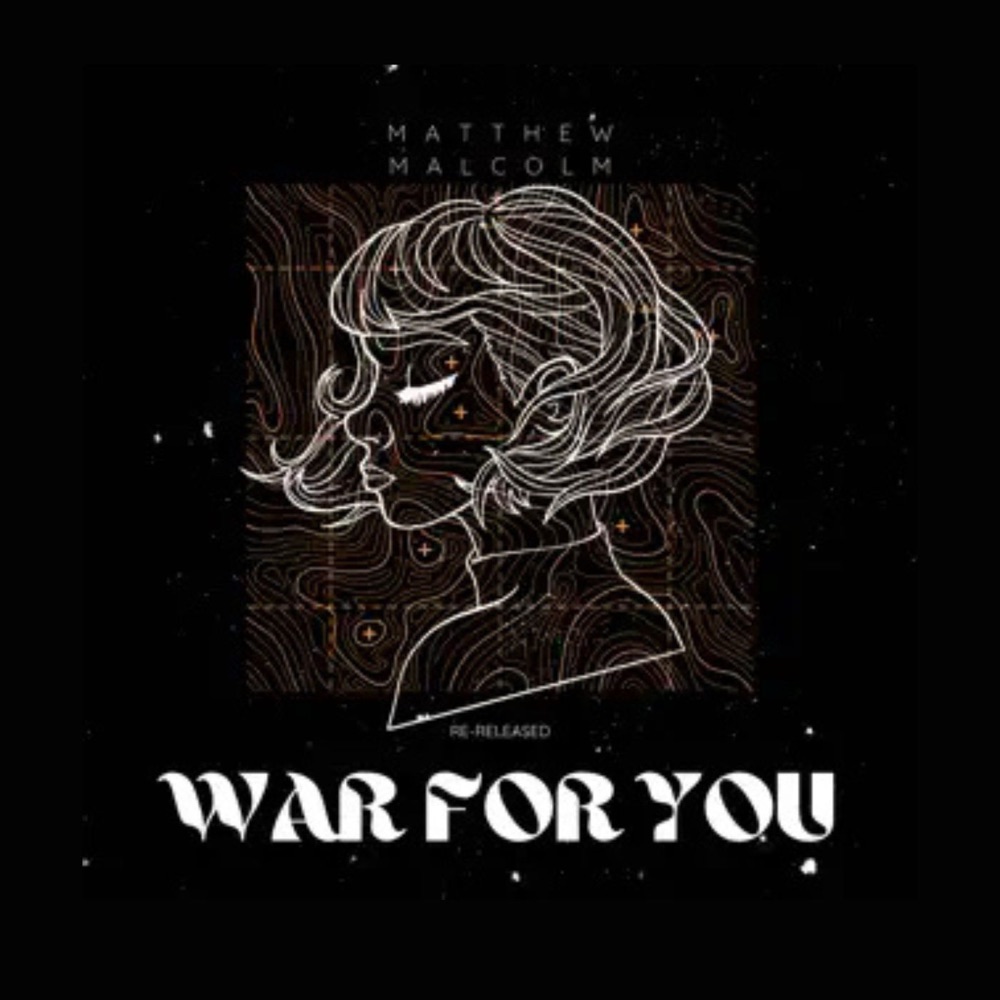
A number of solo singles are out. Matthew Malcolm has released several songs throughout the years: War For You, Beautiful, Y.O.U, Unholy – seems like you specialize in love songs? Or is it mere coincidence?
Coincidence I’d say, mainly because of my influences. I’ve always tried to cater to a more female audience. Not for any special reason, but I do know that more music needs to be leaned towards talking about women in a clean way. We don’t have much of that. If we’re talking about explicit contents, we need to over gratify it, we need to make it everything that’s bad. I wouldn’t want to have more than just a child, I have siblings who are females, and I wouldn’t want them to feel that the only way to be sexy is to be called something derogatory. So, I make music in a way where anybody at all – you could send this to your wife, you guys could be on date night, whatever the vibe is, if you want to say sorry: we got music for all of that.

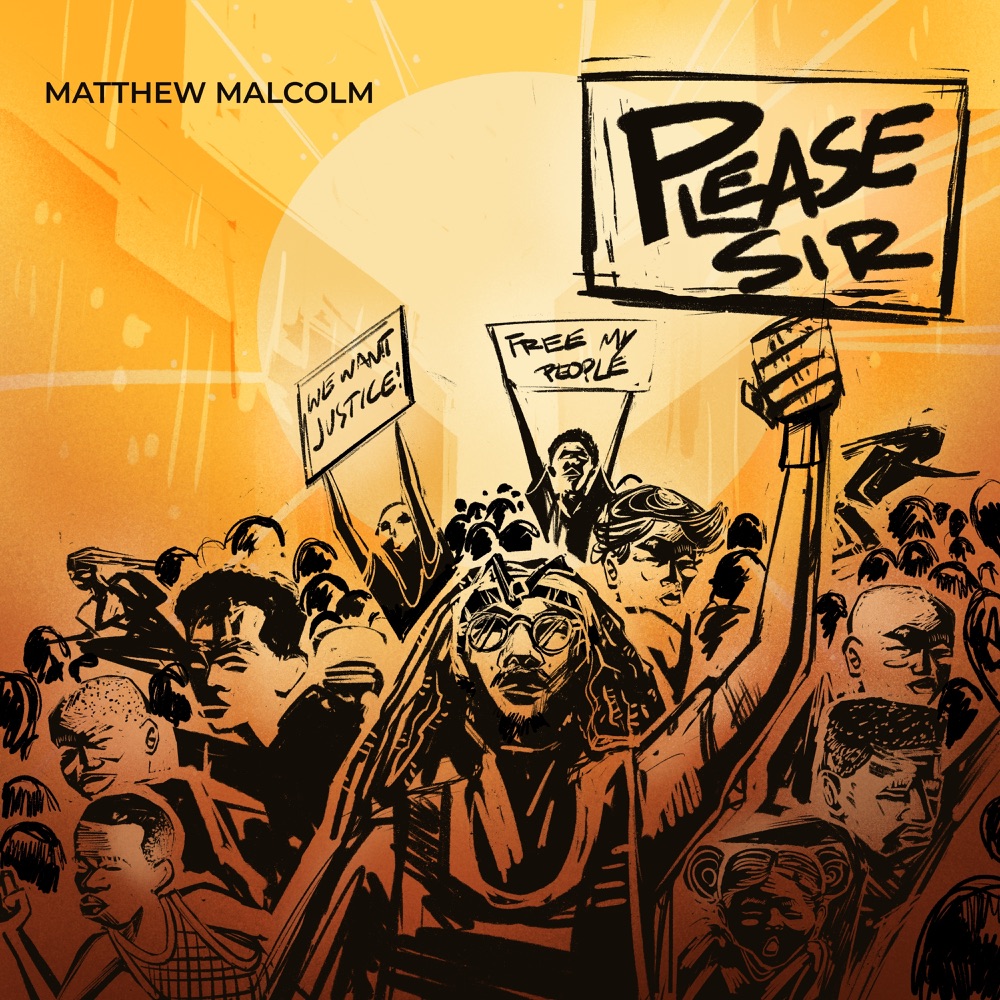
In the early stages it was more catering to the female audiences but now over the years of growing and getting more familiar with myself, growing into that sense of maturity, you realize that there is a mission. The mission can’t just be all lovey-dovey all the time and it can’t be all “let’s jump in a van and go and rave, party, party, party”. We’re talking about real life and real-life situations here. Please Sir is one of those songs that reflects that entirely. “Rolling on my wheels through Jamaican streets, where the sound of reggae gave birth to the dancehall beat. Reality hits right between my eyes when I see a three-year-old hustle in the street, dem cry ‘Please, Sir, can I get some food to eat, Sir? Hungry and I feel so weak, Sir, and I got to hit these streets.’” It speaks of these kids who have the determination that we as brothers had.
When we were young, we had this determination that we had to get it but we didn’t want handouts. We were working for our own. I see so much of that in the streets of Jamaica. As much as it hurts me to my core that kids eight, nine, ten have to be out in the streets hustling, I’m happy that they’re trying to make something of themselves even in that capacity. I’m super proud to just see them creating business out the air, not begging people something. They’re asking, could you buy something for me? Because I need to go to school tomorrow. The deep inspiration again from that song comes from the determination of these kids, who are resilient and strong.
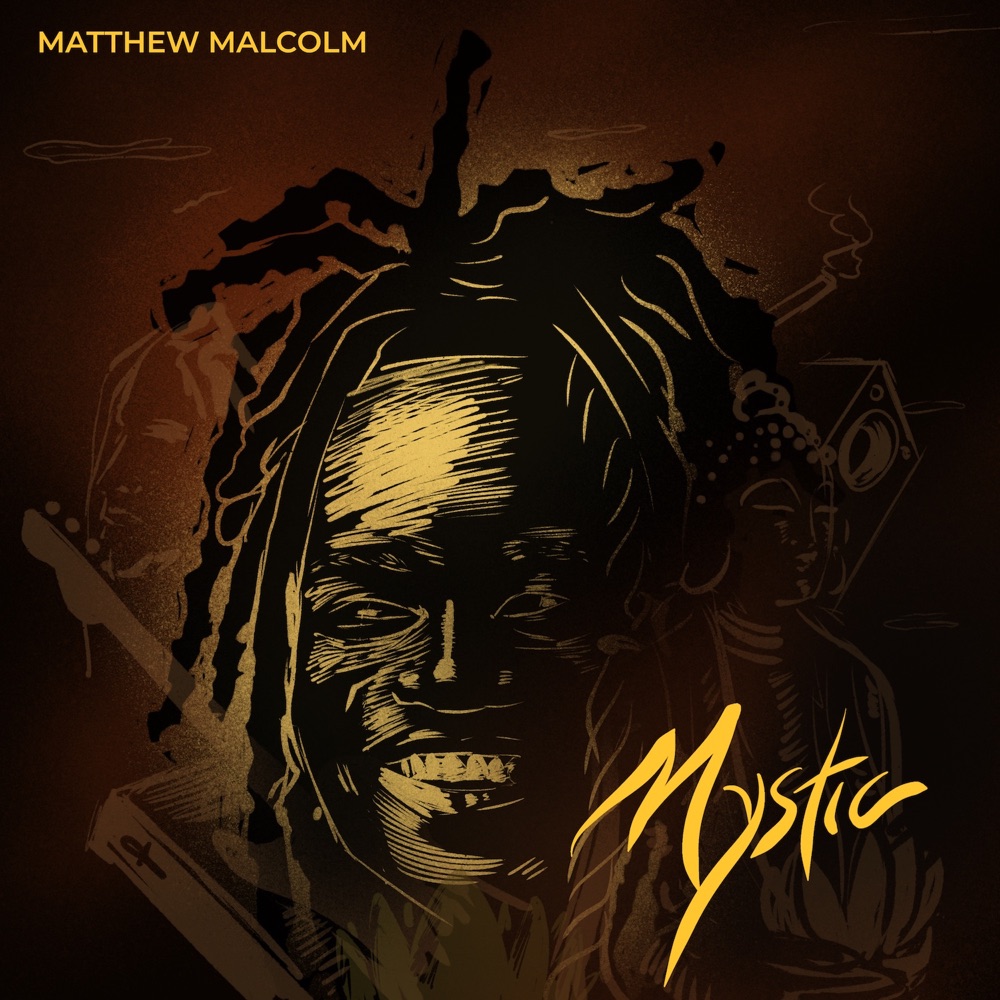
I absolutely appreciate this conscious social commentary track. You also released Mystic recently, celebrating the ganja plant. As we can obviously see, you have a variety of topics. Can we expect more of those types of conscious songs in the future?
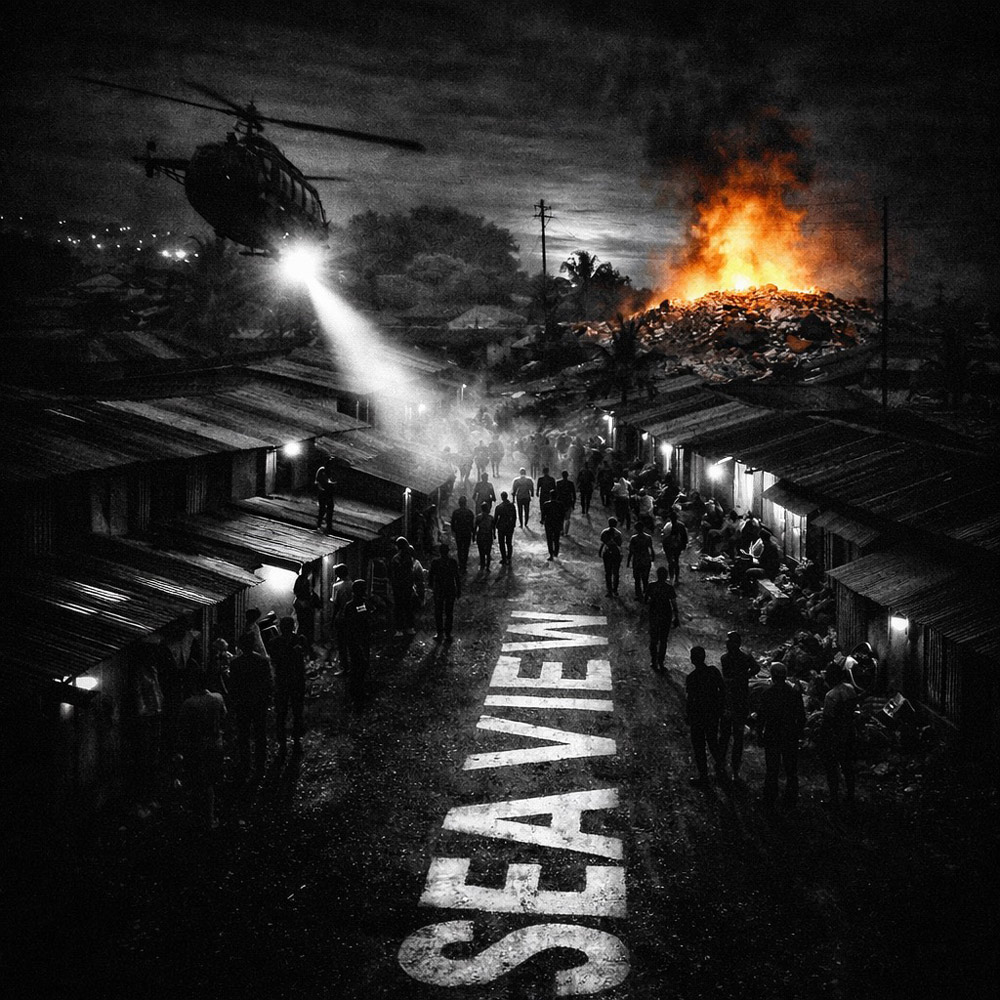
Yes, absolutely. On February 20th, we’re releasing Seaview which is also one of that type of songs that speaks on what’s happening, reflecting the times. How simple it is to just be in a tit-for-tat little argument, and you could lose your life. That’s the society in which we’re living. You could step on a shoe and lose your life. Nobody is really shedding light on that. We’re rather talking about chilling and let’s go to some party and rave. But when we’re in these partys, a fight could brake out because I stepped on somebody’s shoes. It’s shedding light on these simple things so that, I hope, people realize that we’re still living in a society where we’re glorifying the simple things and taking to heart the things that really don’t matter.
Yes, it’s very important to address these matters. What are you working on right now and what can fans – and future fans – expect from Matthew Malcolm?
Right now, for 2026 we’re doing singles. It’s going to continue to be singles right throughout the year. But then we’re dropping a project at the later part of the year, which is a mixtape where we’re taking all, maybe about four tracks, that you and people are already familiar with, and we’re doing our own spins on them releasing that as a mixtape. Onwards we are looking forward to early 2027 to release an album. You are already hearing songs that could potentially be on the album. I know Please Sir is one of them for sure.
Nice man! So, we have nuff things to look forward to. That’s excellent! What would you like to add to our conversation that I didn’t ask you for?
As far as I can see, I can say that the future looks bright, not just with Matthew Malcolm but with all the collabs and works that we have coming forward. We have collaborations with Yaksta, Teejay and Afro B. We have collaborations with young artists such as Xhea, Irie Souljah, as you know Irie. There is a lot of work coming for 2026 and 2027. I must say that I appreciate everybody who has been looking out, who has been contributing still to the reggae industry. My responsibility or message is just to carry on those works. To not let it be a case where it got wasted. All the hard work of the promoters, all the hard work of the managers over the years, the PR, the A&Rs, whoever. It’s our responsibility to continue to make good music, promote good music. That’s all I have to say right now in the fullness. Just appreciation and love!